


Welcome to Antiquesmart.com !
"The new way to buy and sell old things!"
What would you like to do Today ?





List Item
Welcome to Antiquesmart.com !
"The new way to buy and sell old things!"
What would you like to do Today ?
List Item
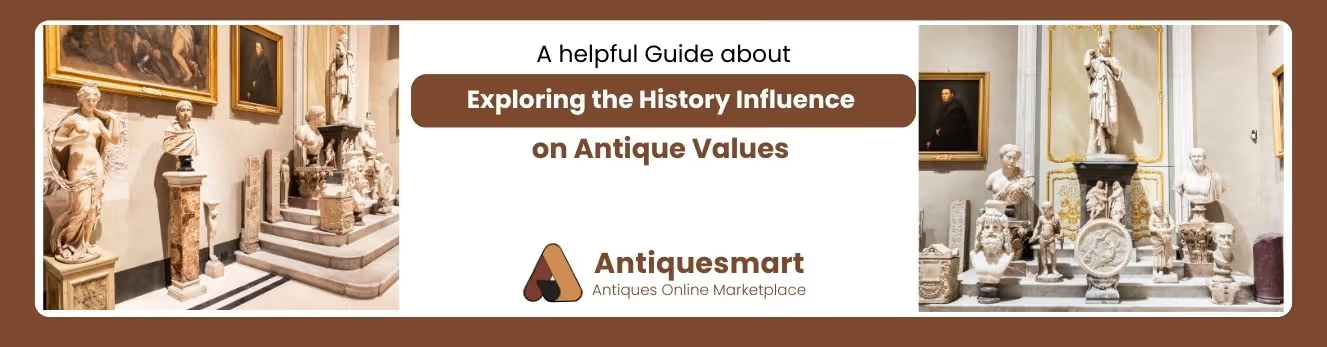
The history influence on antique values is neither abstract nor subjective. It is measurable, legally defined, and empirically supported by auction data, academic research, and global market performance indicators. In contemporary valuation science, antiques derive worth not simply from age, but from a layered interaction of historical context, documented ownership history, cultural era significance, provenance value impact, and legal authenticity frameworks.
In today’s data-driven collectible economy, history functions as a quantifiable pricing mechanism, not a sentimental narrative. Auction premiums, provenance multipliers, and long-term appreciation trends consistently demonstrate how history affects collectible worth across furniture, fine art, jewelry, weapons, and decorative arts.
Understanding the historical impact on antique pricing therefore requires a multidisciplinary lens—combining valuation methodology, historical events, legal frameworks, authentication technology, and market behavior. This article examines those forces through verified data, real-world case studies, and global market statistics to establish authoritative insight into antique valuation.
Antique valuation is, at its core, historical valuation. Without historical context, an object is merely old; with context, it becomes culturally significant, scarce, and investable. The era significance in valuation determines whether an item is treated as decorative resale inventory or as a museum-grade historical asset.
Professional appraisal methodology consistently identifies historical relevance as a primary price determination factor—ranking alongside condition, rarity, craftsmanship, and authenticity. Items associated with identifiable historical periods, movements, or events demonstrate stronger price stability and superior long-term appreciation.
History provides meaning, and meaning creates demand. Demand, in turn, drives value.
In valuation research, storytelling is not emotional—it is economic. Antiques connected to specific time periods, cultural movements, or historical events consistently outperform visually comparable objects lacking context. This is because collectors value interpretability: the ability to place an object within a known historical narrative.
This is precisely why storytelling marketing improves conversion rates by 30%, according to collectible sales reports. Buyers are not simply acquiring materials; they are acquiring epochal rarity, societal influence on design, and cultural continuity.
An 18th-century chair is not valued for wood alone—it is valued as evidence of how people lived, sat, governed, and expressed status during its era. That interpretive layer directly affects collectible appreciation and resale liquidity.
Provenance refers to an item’s documented ownership history, often described as its biography or chain of custody. This documentation may include origin records, historical invoices, inheritance records, exhibition catalogs, museum references, and scholarly citations.
From a valuation science perspective, provenance reduces informational asymmetry. It transforms uncertainty into legitimacy. Academic valuation research consistently confirms that provenance is one of the strongest price multipliers in the antique market because it verifies authenticity, legality, and historical continuity simultaneously.
In high-value segments, provenance is no longer optional—it is foundational.
The antique market history factors influencing modern prices are clearly reflected in global statistics. Antiques are not fringe assets; they represent a mature, diversified global market with measurable growth and investment appeal.
In 2024, the global antique and collectibles market is valued between $238.1 billion and $245.24 billion USD. Long-term projections estimate expansion to $402.9–$453.24 billion by 2033–2034, reflecting a 5.5%–7.1% CAGR.
Online antique sales exceeded $10 billion in 2024, growing at 18% annually. This growth illustrates how digital discovery and mobile research enhance market accessibility while preserving traditional auction dominance for high-value transactions.
Rather than replacing offline channels, online platforms expand liquidity by improving research efficiency and global exposure.
The United States leads the global market with $65.2 billion in sales, accounting for 36% of total global activity. Europe remains influential through established markets in the UK, France, and Germany, supported by centuries of cultural production and robust auction infrastructure.
China commands 32.4% of the Asia-Pacific market, driven by intense demand for culturally significant artifacts. The sale of a Ming Dynasty vase for $24.5 million in 2023 exemplifies how Asian artifacts’ historical significance pricing dominates high-end auctions when provenance, rarity, and cultural importance converge.
Historical context antiques derive value from more than chronology. Valuation models reward time-period craftsmanship, societal influence on design, cultural symbolism, and epochal scarcity—all of which are rooted in history.
Historical context determines whether an object is viewed as decorative, collectible, or culturally indispensable.
Antiques from different eras reflect distinct technological capabilities, resource availability, and aesthetic priorities. Renaissance antiques emphasize artisanal mastery, Victorian-era furniture reflects industrial expansion and social stratification, while Industrial Revolution collectibles represent technological transition.
These differences directly influence durability, rarity, and historical furniture pricing benchmarks.
From a market perspective:
Antique furniture represents 42% of global antique sales
Jewelry and watches account for 28%
Fine art leads at $50.5 billion
Each category is deeply influenced by historical origin and production context.
Cultural movements establish long-term demand patterns by defining artistic and functional standards that later generations seek to preserve.
Renaissance antiques market value remains elevated due to limited production, master craftsmanship, and historical prestige. These items frequently bear maker marks, documented workshop origins, and pre-1900 provenance, meeting modern museum acquisition standards.
Collectors value these pieces as foundational expressions of Western art and design.
Industrial Revolution collectibles gain value precisely because they mark the beginning of mass production. Early examples exhibit transitional craftsmanship—neither fully handmade nor fully mechanized—making them rare survivors of economic transformation.
Their value lies in representing structural change rather than decorative excess.
Provenance value impact is not theoretical—it is empirically verified.
Holy Cross economics research demonstrates that antiques with documented ownership history averaged $314,765, compared to $44,655 for unprovenanced items—a 7x provenance multiplier.
After the 2005 Getty Trial, provenanced antiques experienced a 1,437% price surge, while unprovenanced items rose only 139%. During the trial period, provenance added 71.5% to auction prices and 71.8% post-trial, permanently restructuring valuation models.
This represents one of the clearest examples of provenance premium quantified research in collectible markets.
Royal provenance or ownership by significant historical figures generates 20%–100% value premiums. Such ownership confers both scarcity and cultural authority.
Survey data shows 78% of buyers require authenticity certification, reinforcing that legitimacy confirmation now outweighs aesthetic appeal alone in high-value transactions.
What historical events increase antique value depends largely on survival rates and supply destruction.
War artifacts, disaster survivor pieces, and cultural revolution antiques command premiums because history removes supply while increasing narrative significance. WWII artifacts valuation remains strong, particularly when items carry authenticity certificates and pre-1970 UNESCO documentation.
Destruction creates scarcity; scarcity amplifies value.
The 1973 oil embargo antique prices collapse is a landmark market shock case study.
Oak commodes fell to $12 (from $35+)
Oak bureaus dropped to $35
Raised panel desks collapsed to $150
Transportation paralysis dismantled regional trade models, forcing widespread dealer closures. This illustrates how economic crisis collectible values can react immediately to macroeconomic disruption.
Antiques experience cycles, but historically grounded assets demonstrate greater resilience.
Antique furniture prices declined -7% annually in 2005, 2006, and 2009, while 2007–2008 marked a bottom at -1%. These cycles reveal how market fluctuation causes interact with historical demand and generational taste shifts.
During COVID-19, speculative collectibles surged. A Super Mario Bros. 3 game dropped 60–75%, falling from $3,000–$5,000 (2022) to $1,200 (2023).
This contrast illustrates how pandemic bubble antique market crashes disproportionately affect trend-driven assets, not historically anchored antiques.
15th/16th-century Scottish Claymore sword: £30,000
17th-century Indian lacquer box: £10,500
WWII Walther P.38: $1,300
These examples reinforce how medieval weapon appraisal and wartime artifacts valuation depend on provenance, rarity, and condition—not hype cycles.
Auctions account for 52% of high-value sales, while offline channels retain 67.2% market share. However, 68% of buyers research online, confirming that digital platforms enhance—not replace—traditional auction authority.
Millennials represent 32% of buyers, Gen Z interest in vintage jewelry increased 15% in 2024, while collectors aged 50+ still dominate at 54%.
Sustainability antique buying boosts engagement, with 19% higher CTR for eco-focused listings, aligning antiques with modern ethical investment values.
40% of collectors buy for long-term investment
61% of searches occur on mobile
Instagram drives 27% of traffic
Storytelling improves conversion by 30%
These behaviors confirm antiques’ role in investment diversification and inflation hedge strategies.
Forgery detection, scientific testing, expert appraisal reports, and certificates of authenticity underpin buyer confidence. Advances in authentication technology significantly reduce legitimacy risks and improve market transparency.
The 1970 UNESCO Treaty, 1982 Cultural Property Implementation Act, and 2005 Getty Trial redefined legal provenance requirements. The Getty trial permanently altered antique pricing structures by making provenance central to value determination.
Download the Antiquesmart app for Iphone and Android
.avif)

The history influence on antique values is measurable, repeatable, and supported by empirical data. Provenance premiums range from 20% to over 1,400%, while historical market shocks can erase 50–75% of speculative value.
In the modern antique market, history is not nostalgia—it is a pricing algorithm.
History does not merely influence antique values—it defines them. As global markets expand and authentication standards tighten, historical integrity will remain the most powerful asset an antique can possess.
Historical provenance affects antique value by establishing a verified documented ownership history, which significantly reduces authenticity risk and increases buyer confidence. When historical provenance affects antique value positively, auction data shows price increases ranging from 20% to over 700%, depending on the strength of the chain of custody, exhibition history, and legitimacy confirmation. Antiques with uninterrupted provenance documentation consistently outperform similar objects without historical records.
The percentage increase that documented history adds to antique auction prices is both measurable and substantial. Academic valuation research demonstrates that documented ownership history can add 71% to 1,400% to final hammer prices. Studies following the 2005 Getty Trial confirmed that antiques with verified historical documentation achieved a 7x provenance multiplier, proving that documented history directly influences antique pricing outcomes.
Historical events that have the greatest impact on antique values include wars, economic crises, cultural revolutions, and major legal interventions. Events such as World War II, the 1973 oil embargo, and the 2005 Getty Trial reshaped supply availability and legal standards, permanently altering antique market history factors. In many cases, these historical events increase antique value by destroying supply or tightening provenance requirements.
The 2005 Getty Trial changed antique pricing structures by redefining the importance of legal provenance and cultural property compliance. After the trial, buyers, museums, and auction houses demanded stricter origin documentation and authenticity certification, causing provenanced antiques to rise by 1,437%, while unprovenanced items saw only marginal growth. This legal shift permanently elevated the historical impact on antique pricing.
To verify the historical authenticity of an antique before buying, collectors rely on expert verification, scientific testing, appraisal reports, and certificates of authenticity. Verifying historical authenticity also involves reviewing ownership records, literature references, museum comparisons, and compliance with UNESCO 1970 treaty standards. Proper authentication directly protects value and strengthens long-term collectible appreciation.
Gaps in provenance documentation can sometimes be filled to increase antique value, but only through credible valuation research and archival evidence. Filling provenance gaps may involve locating exhibition catalogs, customs records, estate inventories, or historical photographs. While complete chains of custody yield the highest premiums, even partial documentation can improve how historical context affects collectible worth when verified by experts.
Download the Antiquesmart app for Iphone and Android