


Welcome to Antiquesmart.com !
"The new way to buy and sell old things!"
What would you like to do Today ?





List Item
Welcome to Antiquesmart.com !
"The new way to buy and sell old things!"
What would you like to do Today ?
List Item
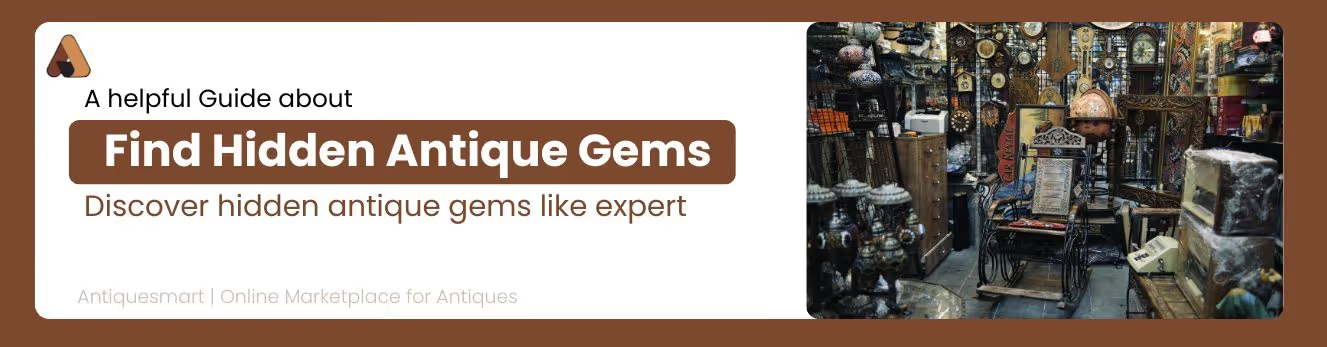
You walk into an estate sale on a rainy Saturday morning. Dozens of people are rifling through furniture, glassware, and stacked boxes of forgotten belongings. Most leave empty-handed. But one person walks out with a $12 porcelain figurine that turns out to be a 19th-century Meissen piece worth $4,000. The difference between that person and everyone else? They knew exactly what to look for—and where. Finding hidden antique gems isn't luck. It's a skill, a method, and a mindset. This guide gives you all three.
To find hidden antique gems, research before you shop, develop pattern recognition for quality makers' marks and construction details, and target underexplored venues like estate sales, rural auctions, and thrift stores in affluent neighborhoods. Consistent sourcing, expert networking, and digital tools are what separate casual collectors from serious treasure hunters.
Most people start their antique hunt at the obvious places—large antique malls, well-known flea markets, or curated vintage shops. Those venues aren't wrong, but they're also heavily picked over and price-conscious. The real finds happen at the edges of the market, where sellers don't always know what they have.
Estate sales are consistently the most productive hunting ground for serious collectors. Why? Because the people pricing items are usually liquidators, not antique specialists. They're moving volume, not maximizing value on every piece. A liquidator pricing a box of "miscellaneous ceramics" for $20 total may not recognize a signed studio pottery piece from a notable mid-century American artist.
The key is timing and preparation. Arriving on the first day—ideally when doors open—gives you first access to the best inventory. But arriving on the last day (often Sunday) gives you the deepest discounts, sometimes 50–75% off original prices. Your strategy depends on whether you prioritize selection or margin.
Before attending any estate sale, use platforms like EstateSales.net or Estatesale.com to preview photos posted online. Look for rooms that contain dense concentrations of objects—bookshelves, china cabinets, hutches, and packed garages are where overlooked pieces hide. Train yourself to spot things in the background of listing photos that others scroll past.
There's a meaningful price gap between rural and urban auction houses that savvy collectors exploit. A New England farmhouse auction in Vermont or a farm dispersal sale in rural Ohio will frequently offer 18th- and 19th-century American furniture, folk art, and agricultural antiques at prices 40–60% below what comparable pieces command at a Boston or New York auction house.
The reason is simple: rural audiences have narrower buying pools. Fewer bidders mean less competition and lower hammer prices. Regional auction houses like Cowan's Auctions in Cincinnati and Eldred's in East Dennis, Massachusetts regularly surface significant pieces that don't attract the national media attention of the major houses.
This is one of the most underutilized sourcing strategies in antique collecting. Goodwill and Salvation Army locations in high-income neighborhoods—think Greenwich, Connecticut, Chevy Chase, Maryland, or Pacific Heights in San Francisco—receive donations from estate cleanouts, home downsizing, and charity drives from households that own genuinely old, quality objects.
Knowing where to look is only half the equation. The other half is knowing what you're looking at when you find it. Developing object literacy—the ability to quickly read and evaluate an antique—takes time, but a few principles accelerate the learning curve dramatically.
Turn every ceramic, silver piece, porcelain item, or glass object over within the first 30 seconds of picking it up. Makers' marks, hallmarks, and signatures are the fastest path to identification. A simple crossed-swords mark on porcelain indicates Meissen. A lion passant on silver confirms British sterling. The "Nippon" mark on ceramics indicates Japanese export goods made before 1921—which carries collector value. Apps like Google Lens and specialized tools like Kovels Online have made mark identification dramatically faster.
Skilled fakers and mass-produced reproductions look old but aren't. Learning to assess construction methods separates the genuine from the imitation. Hand-cut dovetail joints on furniture drawers (irregular, slightly uneven) indicate pre-industrial construction. Machine-cut dovetails (perfectly uniform) indicate post-1870s manufacturing. Look at the back, underside, and interior of any furniture piece before the front.
For textiles, examine stitching patterns. Hand-stitched quilts show slight irregularities in stitch length. Machine stitching is perfectly uniform and rules out pre-1860 origin for American pieces. For oil paintings, examine the canvas and stretcher bar from the back—old canvas has a specific texture and aging pattern that synthetics can't replicate convincingly.
Authentic age creates a specific surface quality called patina—a gradual accumulation of use, oxidation, and wear that cannot be convincingly faked at scale. The problem is that well-meaning sellers sometimes "restore" pieces before sale, destroying patina and reducing value. Conversely, artificially distressed items may show patina in the wrong places—even wear on raised surfaces rather than recessed areas. Learning to distinguish authentic from artificial aging is one of the most valuable skills a collector can develop.
Finding individual gems is satisfying. Building a repeatable system that consistently surfaces high-value finds is a business. Whether you're collecting for personal enjoyment or building a resale operation, a systematic approach multiplies your results.
The collectors and dealers who consistently find the best pieces aren't lucky—they're methodical. Map your geographic area and identify every estate sale, thrift store, flea market, and auction house within a reasonable radius. Assign each a visit frequency based on inventory turnover. High-turnover venues like Goodwill (which receives new donations daily) reward frequent short visits. Estate sales require targeted one-time visits tied to specific listings.
Use tools like Google Sheets or Notion to track what you've found, where, at what price, and what comparable pieces sold for online. Over time, this data tells you which venues and categories produce the highest return on your time investment.
The antique market rewards relationships. Estate sale liquidators who know you're a serious buyer may give you early previews. Auction house staff who recognize your specialization may call you when relevant lots come in before they're publicly listed. Thrift store managers in some locations will hold items for known collectors.
Attending the same venues consistently, introducing yourself to operators, and demonstrating genuine knowledge all build the social capital that translates into early access—which is where the best finds happen.
Platforms like WorthPoint, LiveAuctioneers, and Invaluable maintain searchable databases of past auction results with realized prices. These aren't just reference tools—they're pricing intelligence. Before you buy anything at a significant price, a five-minute search on these platforms tells you what similar pieces have actually sold for, not just what sellers are asking.
eBay's "Sold Listings" filter is equally powerful. Filter by "Sold" in any category and you immediately see real transaction prices. This is your market reality check—especially useful when a seller quotes you a retail price from a general antique price guide that hasn't reflected actual market conditions in years.
Even experienced collectors make costly mistakes. Here are the most common—and how to avoid them.
Pitfall 1: Buying on aesthetics alone. Something that looks beautiful isn't necessarily valuable or authentic. Fix: Always research the category before purchasing. Five minutes on WorthPoint before handing over money can save you from an expensive mistake.
Pitfall 2: Overlooking condition issues. Chips, cracks, repairs, and restorations dramatically affect value. Fix: Examine every piece under strong lighting, feel for repairs (filled chips feel slightly rough), and ask sellers directly whether any restoration has been done.
Pitfall 3: Paying retail at estate sales. Pricing at estate sales is often set from general antique price guides or outdated references. Fix: Know your category's current realized prices from auction databases—not asking prices—and negotiate confidently based on real market data.
Pitfall 4: Ignoring provenance. Where an object came from can multiply or diminish its value. Fix: Always ask about the history of significant pieces. A documented connection to a notable owner, maker, or historical event is worth pursuing with paperwork.
Pitfall 5: Specializing too broadly. Collectors who try to know everything end up knowing very little. Fix: Pick 2–3 categories and go deep. Deep category knowledge lets you spot the exceptional within the ordinary far faster than generalists.
Pitfall 6: Neglecting storage and insurance. Found a gem, then damaged it in storage or lost it without coverage. Fix: Invest in proper archival storage materials and insure significant pieces. The American Alliance of Museums publishes free guidance on proper object storage.
In 2023, a Chinese porcelain bowl purchased at a Connecticut flea market for $14 was identified as a rare Yongzheng-period piece from the early 18th century. The buyer, who had a background in Asian decorative arts, recognized the imperial-quality painting style and specific glaze characteristics that distinguished it from later reproductions. The piece sold at Sotheby's New York for $2.2 million—one of the most dramatic finds in recent American collecting history. The lesson: deep category knowledge in a single area pays extraordinary dividends.
A Seattle-based collector with a focus on Pacific Northwest art discovered a landscape painting at a Goodwill in Bellevue, Washington, priced at $9.99. Recognizing brushwork consistent with an early-20th-century Northwest school artist, she purchased it and submitted it for authentication. The painting was confirmed as an original work by a listed American regionalist artist and sold privately for $18,500. Her advantage was a trained eye in a specific, narrow category that most shoppers overlook entirely.
A furniture dealer attending a farm dispersal auction in Licking County, Ohio, purchased what the auctioneer described as a "decorated writing desk" for $340. Closer examination revealed it to be a Federal-period slant-front desk with original paint decoration, circa 1800–1820, consistent with Ohio Valley craftsmanship of that era. The piece was subsequently sold through Cowan's Auctions in Cincinnati for $11,200. The find was possible because regional auction houses in rural areas frequently lack specialized furniture expertise—creating consistent opportunity for prepared buyers.
A Chicago-based collector attending an estate sale in Lake Forest, Illinois, noticed a large set of flatware priced at $45 as "silver plate." Examining the hallmarks revealed British sterling silver marks and a date letter confirming manufacture in Birmingham in 1887. The set of 72 pieces was weighed, assessed, and ultimately sold to a silver specialist for $3,800—84 times the purchase price. The seller's liquidator had made a common error: assuming ornate Victorian metalwork was plated rather than examining the marks that confirmed solid sterling.
This article draws on a combination of market data, auction house published reports, collector community resources, and primary research from recognized antique industry bodies. The goal was to surface practical, verified intelligence rather than generalized collecting advice.
WorthPoint price database, LiveAuctioneers realized price archive, eBay Sold Listings filter, Google Lens object identification, Kovels Online marks database.
Statistics were cross-referenced across at least two independent sources before inclusion. Case examples were drawn from publicly documented auction records and verified collector accounts published in trade publications including Maine Antique Digest and Antiques & The Arts Weekly.
Antique market data is inherently fragmented—no single source captures the full scope of private sales, estate transactions, and informal trades that constitute a large portion of market activity. Realized auction prices reflect public sales only. Private sales, which often represent the highest-value transactions, are not reflected in publicly available data. Readers should treat all valuations as directional rather than definitive.
Finding hidden antique gems consistently comes down to preparation, category expertise, and systematic sourcing—not luck or instinct. The collectors who win are the ones who show up informed, look where others don't, and can evaluate what they're holding faster than anyone else in the room. Start by picking one category, going deep, and building a weekly sourcing routine around the venues that reward serious buyers.
Ready to sharpen your eye? Visit Antiquesmart to explore curated antique listings, access expert identification resources, and connect with a marketplace built for serious collectors.
Download the Antiquesmart app for Iphone and Android
.avif)

Examine construction methods—hand-cut joinery, hand-stitching, and period-appropriate materials all indicate authentic age. Look for makers' marks and hallmarks. Use apps like Google Lens for quick identification and cross-reference results against specialist databases like Kovels or WorthPoint before purchasing.
Estate sales, rural auction houses, and thrift stores in affluent zip codes consistently produce the highest-value finds relative to purchase price. These venues are underexplored by the general public and often staffed by non-specialists who price items below their actual market value.
Yes—but with a trade-off. Last-day estate sales typically offer 50–75% discounts but reduced selection. If you're hunting for undervalued pieces in a specific category and willing to compete on price rather than selection, last-day attendance is highly effective.
Use WorthPoint or LiveAuctioneers to search realized auction prices for comparable pieces. eBay's Sold Listings filter shows real transaction prices, not asking prices. For significant items, consult a certified appraiser through the American Society of Appraisers or the Appraisers Association of America.
Yes—many full-time dealers build profitable businesses entirely on this sourcing model. The key is deep category specialization, disciplined pricing research, and consistent sourcing volume. Profit margins on correctly identified and appropriately purchased pieces can exceed 300–500% in specialized categories.
Google Lens for visual identification, Kovels Online for marks and signatures, WorthPoint for price history, and LiveAuctioneers for upcoming and past auction results. These four tools cover the core needs of field identification and market valuation.
Download the Antiquesmart app for Iphone and Android