

Welcome to Antiquesmart.com !
"The new way to buy and sell old things!"
What would you like to do Today ?





List Item
Welcome to Antiquesmart.com !
"The new way to buy and sell old things!"
What would you like to do Today ?
List Item
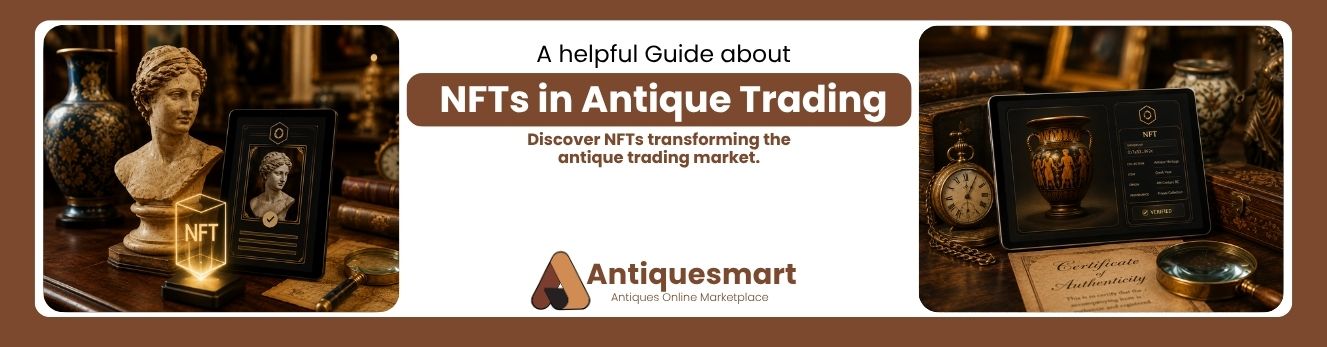
The antique world has always been defined by provenance, authenticity, and the irreplaceable nature of physical objects. A Georgian silver teapot, a first edition Hemingway, a signed Tiffany Studios lamp — these objects derive their value precisely from their physical reality, their documented history, and the impossibility of perfect duplication. For centuries, the antique trade has operated on trust, expertise, paper documentation, and the slow accumulation of reputation that separates reliable dealers from unreliable ones.
Now, for the first time in that history, a technology has emerged that challenges some of the antique world's most fundamental assumptions about how provenance is documented, how authenticity is verified, and how ownership is transferred and recorded. That technology is the non-fungible token — the NFT.
The conversation about NFTs in the antique world is genuinely complex, frequently misunderstood, and more nuanced than either the enthusiastic technologists who see NFTs as the solution to every provenance problem or the skeptical traditionalists who dismiss them as irrelevant to the physical object trade. The reality, as is usually the case with transformative technologies, lies somewhere more interesting than either extreme position.
NFTs are not going to replace antiques. They are not going to make physical objects obsolete or transform the fundamental human desire to own beautiful, historically significant things. But they are beginning to change specific aspects of how the antique trade operates — how provenance is documented and transferred, how authentication is recorded, how collectors engage with the objects they own, and how the intersection of physical and digital collecting is being explored by a growing number of dealers, auction houses, and collectors.
This guide gives you a clear, honest, and practically useful understanding of what NFTs are, how they are being used in the antique and collectibles world today, what genuine benefits they offer, what significant limitations they have, and what the future of this technology looks like for antique collectors and dealers.
Before exploring how NFTs apply to antique trading, it is essential to understand clearly what they actually are — stripped of both the hype that surrounded their peak in 2021 and the dismissiveness that followed their market correction.
NFT stands for Non-Fungible Token. To understand what that means, start with the word fungible.
A fungible asset is one where each unit is interchangeable with every other unit of the same type. A US dollar bill is fungible — one dollar is worth exactly the same as any other dollar, and exchanging one for another changes nothing of substance. Bitcoin is fungible — one Bitcoin is worth the same as any other Bitcoin.
A non-fungible asset is one that is unique — where each specific instance has distinct characteristics, history, and value that make it irreplaceable. A first edition of The Great Gatsby is non-fungible — no other copy is identical in every respect to that specific copy, which may carry a specific owner's inscription, a specific condition, a specific provenance history. A Georgian silver candlestick is non-fungible — its specific maker, date, condition, and history are unique to that object.
An NFT is a digital record of ownership of a specific, unique asset — stored on a blockchain. The blockchain is a distributed digital ledger that records transactions in a form that is essentially impossible to alter retroactively, because each transaction record is verified by thousands of computers simultaneously and linked cryptographically to every previous record.
An NFT is not the antique itself. It is a digital certificate — a record stored on a blockchain — that contains:
The blockchain's most important property for antique collectors and dealers is its immutability. Once a transaction is recorded on a major blockchain, it cannot be altered or deleted. This creates a provenance record that is fundamentally different from paper documentation — which can be lost, forged, or damaged — in its permanence and verifiability.
Anyone can verify the complete ownership history of an NFT-documented antique by examining the public blockchain record, without needing to trust the seller's word or the completeness of accompanying paper documentation. This transparency is genuinely novel in the antique world.
The application of NFTs to physical antiques is still early and experimental, but several distinct use cases have emerged that are worth understanding.
The most straightforward and immediately practical application of NFTs in the antique world is as digital provenance certificates — essentially a digital equivalent of the paper certificates of authenticity, auction house receipts, and appraisal reports that have always formed the backbone of antique provenance documentation.
An NFT provenance certificate for an antique can contain:
When the antique is sold, the NFT is transferred to the new owner simultaneously, creating an unbreakable chain of custody documentation that travels with the piece permanently.
This application is gaining traction with major auction houses and specialist dealers as a supplement to — not a replacement for — traditional paper documentation.
Some dealers and auction houses are experimenting with pairing physical antiques with NFTs that unlock related digital content — high-resolution documentation, expert video commentary, 3D scans, conservation notes, and comparable sale records — accessible only to the current NFT holder.
This creates a new kind of collecting experience that combines the irreplaceable physical pleasure of owning an authentic antique with digital resources that deepen understanding and appreciation of the piece.
One of the more theoretically interesting applications of NFTs in the antique world is fractional ownership — the division of a single high-value antique's ownership into multiple NFT shares that can be separately bought, sold, and traded.
A painting worth $10 million, for example, could be tokenized into 10,000 NFT shares worth $1,000 each, allowing multiple investors to hold fractional ownership of a piece that no single individual could afford. NFT smart contracts can automate the distribution of any income generated by the piece — rental fees from museum display, for example — proportionally to all fractional holders.
This model is being explored actively for high-value art and has potential applications for significant antiques, though significant legal and regulatory questions about securities law remain unresolved in most jurisdictions.
A distinct category — separate from physical antiques but worth understanding — is the market for NFTs that are themselves the collectible, without any underlying physical object. Digital artists have created significant markets for NFT-based artwork and collectibles that exist entirely in digital form.
This category overlaps with antique collecting only tangentially, but the collector communities are beginning to intersect — particularly among younger collectors comfortable with both physical and digital collecting.
Separating genuine benefits from hype requires honest assessment of what NFTs actually do better than existing systems.
Solving the Lost Provenance ProblemOne of the most persistent and costly problems in the antique world is provenance documentation that becomes separated from the object it describes over decades of ownership changes. A piece sold at Christie's in 1962 may have a detailed catalog entry documenting its history, but if the paper documentation was discarded or lost by subsequent owners, that history is effectively inaccessible to current buyers.
NFT documentation, once created and linked to an object, travels with it permanently on the blockchain regardless of what happens to any physical documentation. This is genuinely valuable for long-term provenance preservation in a way that paper simply cannot match.
International antique transactions involve significant documentation requirements — customs declarations, authenticity certifications, export permits, and provenance documentation that must cross borders along with the physical object. NFT documentation that is instantly accessible and verifiable from anywhere in the world reduces the friction of these requirements and provides a richer, more easily transmitted documentation package than paper equivalents.
For platforms like Antiquesmart, which connects international buyers and sellers of antiques without commission fees, NFT provenance documentation offers genuine practical benefits for the cross-border transactions that the platform increasingly facilitates.
NFT smart contracts can be programmed to automatically pay a percentage royalty to a previous owner — or to the original maker's estate — every time a piece changes hands. This royalty mechanism, which does not exist in traditional antique sales, opens new possibilities for arrangements between collectors, dealers, and living artists or their estates.
No responsible discussion of NFTs in the antique world can avoid the genuine limitations and legitimate criticisms of the technology.
The most fundamental limitation of NFTs as applied to physical antiques is that the NFT and the antique are two separate things. The NFT is a digital record about the object — it is not the object itself and has no inherent physical connection to it.
This means that an NFT can be transferred without the physical object being transferred, and the physical object can be sold without the NFT being transferred. The NFT provenance record is only valuable if the link between the digital record and the physical object is maintained scrupulously throughout every ownership change — and that maintenance ultimately depends on human behavior rather than any technical guarantee.
Physical linking solutions — microchips embedded in objects, NFC tags, QR codes — partially address this problem but introduce their own vulnerabilities. A chip can be removed and placed in a different object. A QR code label can be transferred. The fundamental problem of linking a digital record to a physical object has not been fully solved.
An NFT is only as reliable as the information that was put into it when it was created. If an NFT provenance certificate is created with inaccurate, fraudulent, or fabricated information — false attribution, invented ownership history, forged appraisal records — the blockchain will record and preserve that false information just as permanently and immutably as it would record accurate information.
NFTs do not verify the truth of the information they contain. They only verify that specific information was recorded at a specific time and has not been altered since. The initial authentication and documentation problem — establishing what is actually true about a piece at the moment of NFT creation — remains entirely dependent on traditional expert knowledge and judgment.
The NFT market experienced a spectacular speculative bubble in 2020–2021, with some digital NFT artworks selling for tens of millions of dollars, followed by an equally dramatic market correction in 2022 that saw values collapse by 80–90% or more for most categories of NFT. This volatility raised serious questions about NFTs as investment vehicles and damaged the credibility of NFT technology among many traditional collectors and dealers.
The collapse of speculative NFT markets does not invalidate the utility of NFTs as provenance documentation tools — these are separate applications — but the association with speculative excess has made many traditional antique market participants appropriately cautious about NFT involvement.
Early blockchain systems used for NFTs — particularly Ethereum before its 2022 transition to proof-of-stake consensus — consumed extraordinary amounts of electrical energy through their proof-of-work verification systems, generating significant carbon emissions. This environmental concern was legitimate and widely reported.
The Ethereum network's 2022 transition to proof-of-stake reduced its energy consumption by approximately 99.95%, addressing most of the environmental criticism for that platform. However, environmental considerations remain relevant when evaluating different blockchain platforms and should be part of any responsible assessment.
The legal framework governing NFTs — what they represent legally, how ownership disputes are resolved, how they are taxed, whether fractional NFT ownership constitutes a regulated security — varies significantly between jurisdictions and remains unsettled in many important respects.
For antique collectors and dealers operating in multiple jurisdictions, this legal uncertainty is a practical limitation on the deployment of NFT systems for anything beyond voluntary documentation purposes.
Several significant players in the art and antique market have moved beyond discussion into active NFT implementation.
Both Christie's and Sotheby's have held dedicated NFT sales and integrated NFT documentation into selected physical art and antique sales. Christie's made global headlines in March 2021 with the sale of Beeple's digital artwork for $69 million — at that time the third-highest price ever achieved by a living artist at auction — which effectively announced the arrival of NFTs as a serious consideration for the art and antique market.
Both houses have continued exploring the integration of NFT provenance documentation for high-value physical pieces, while maintaining traditional documentation systems in parallel.
Several platforms have been developed specifically for the NFT-documentation of physical art and antiques:
These platforms represent the practical infrastructure through which NFT provenance documentation is being deployed in the physical art and antique market.
Given the genuine benefits, the significant limitations, and the rapidly evolving landscape, what is the practically sensible position for antique collectors and dealers in 2026?
Antiquesmart's community of over 1,000 vendors and 2,000 collectors is well positioned to engage with NFT developments thoughtfully. The platform's emphasis on community knowledge sharing and specialist expertise creates an environment where the genuine benefits of NFT documentation can be explored without the speculative excess that characterized early NFT markets.
The long-term trajectory of NFTs in the antique world will likely be shaped by several developments currently underway.
The most important technical development for physical antiques is reliable, tamper-evident physical linking between objects and their NFT records. Developments in microchip embedding, invisible marking technologies, and multi-factor verification systems are moving steadily toward solutions that make the separation of an antique from its NFT record difficult enough to be practically reliable.
As jurisdictions develop clearer legal frameworks for digital ownership records, the practical utility of NFT provenance documentation will increase. The establishment of NFT records as legally recognized evidence of ownership history — equivalent in legal weight to traditional paper documentation — would be transformative for the antique market.
Insurance companies and estate planning professionals are beginning to engage with NFT ownership records as documentation tools. As this integration matures, NFT provenance records will become part of the standard documentation package for significant antique collections in the same way that written appraisals and auction receipts are today.
Perhaps the most powerful long-term driver of NFT adoption in the antique world is generational. Younger collectors who have grown up with digital assets as a natural category of ownership — and who are increasingly driving growth in both the vintage and antique markets — approach NFT documentation with comfort and familiarity that older market participants typically do not share. As these collectors become an increasingly dominant force in the antique market, demand for digital provenance documentation will grow accordingly.
NFTs represent a genuinely new capability in the antique world — not a revolution that will transform the fundamental human desire for beautiful, historically significant physical objects, but a technology that addresses specific, long-standing problems in how provenance is documented, preserved, and transferred.
The permanent, tamper-evident, instantly transferable provenance record that NFT technology enables is a real improvement over paper documentation in specific respects. The limitations — the disconnect between digital record and physical object, the garbage-in-garbage-out authentication problem, the legal uncertainty, and the reputational damage from speculative excess — are equally real and must be honestly acknowledged.
The antique collectors and dealers best positioned for the future are those who understand both sides of this equation clearly — who can evaluate NFT provenance documentation intelligently when it is offered, who understand what it does and does not guarantee, and who are prepared to adopt the genuine benefits of this technology as it matures while maintaining the traditional expert knowledge and authentication practices that no digital technology can replace.
The finest antiques will always derive their deepest value from their physical reality, their authentic history, and the irreplaceable connection to the human past that they embody. NFTs can help document and preserve that history more reliably. They cannot create or replace it.
Download the Antiquesmart app for Iphone and Android
.avif)

An NFT (Non-Fungible Token) is a unique digital record stored on a blockchain — a permanent, tamper-evident digital ledger. In antique collecting, NFTs are being used as digital provenance certificates that record ownership history, authentication documentation, and condition records in a form that cannot be altered or lost and can be instantly verified by anyone. The NFT travels with the antique through every ownership change, creating a permanent chain of custody record.
No. An NFT records and preserves information about an antique but cannot verify that information is accurate. If an NFT is created with false or inaccurate information — attributing a fake piece to a genuine maker, for example — the blockchain will record that false information permanently. Authentication still requires traditional expert examination and knowledge. NFTs document authenticity claims; they do not verify them.
NFT blockchain records themselves are essentially impossible to forge or alter after creation. However, the connection between a digital NFT record and the physical antique it describes depends on human behavior and physical linking mechanisms that are not yet perfectly reliable. An NFT provenance record is a significant addition to traditional documentation but does not eliminate all fraud risk in the antique market.
The NFT market experienced a dramatic speculative bubble in 2020–2021 followed by a severe correction in 2022, with values for most NFT categories falling 80–90% or more. This collapse primarily affected purely digital NFT artworks and collectibles. The utility of NFTs as provenance documentation tools for physical antiques is largely separate from the speculative digital art market, though the association with speculative excess has made many traditional antique market participants cautious about NFT involvement.
For significant purchases, requesting NFT provenance documentation — alongside traditional paper documentation — is increasingly reasonable as the technology becomes more widely available from specialist dealers and auction houses. NFT documentation should be understood as an additional layer of provenance record, not a replacement for traditional expert authentication or established paper provenance chains.
Christie's and Sotheby's have both held dedicated NFT sales and integrated NFT documentation into selected physical art and antique sales. Specialist platforms including Verisart and Artory provide blockchain certificate services working with galleries and auction houses. The integration of NFT documentation into mainstream antique auction sales is still developing rather than universal.
Download the Antiquesmart app for Iphone and Android